

Infection Control Market to reach USD 213.38 Billion by 2035 at 6.90% CAGR
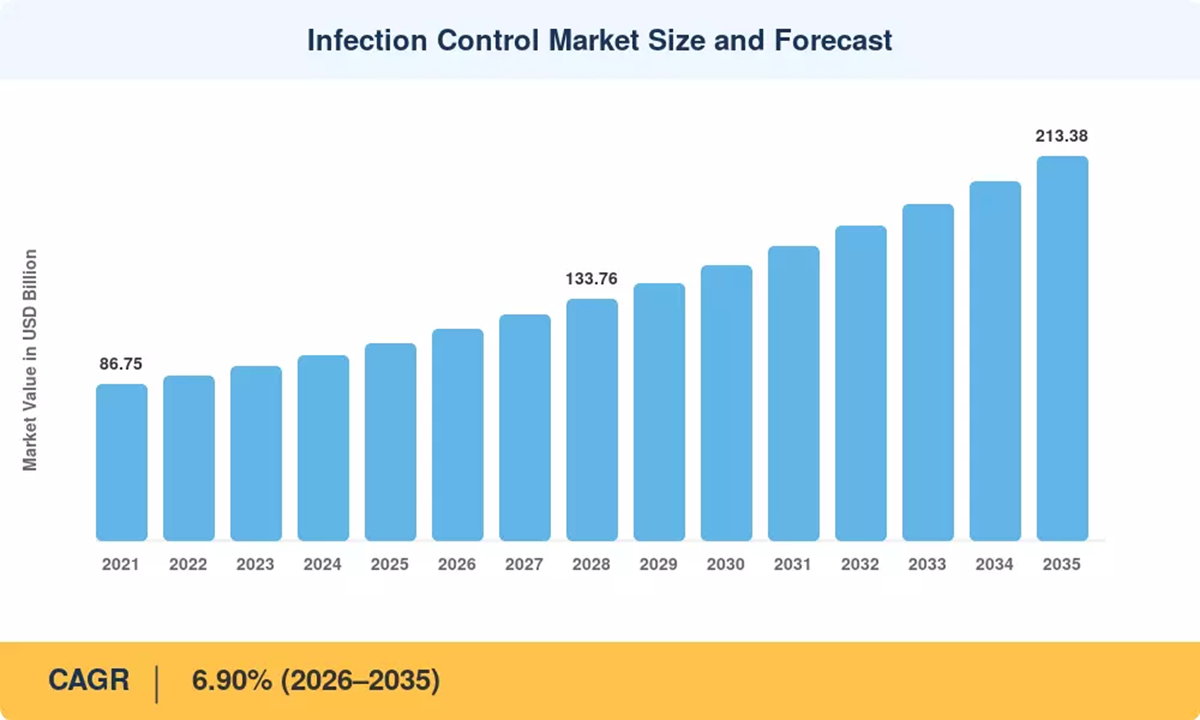
Infection Control Market Size
Infection Control Market to Surge from USD 117.06 Billion in 2026 to USD 213.38 Billion by 2035-By CMS HAI Penalty Enforcement, EPA Ethylene Oxide Regulations
NY, CA, UNITED STATES, August 21, 2026 /EINPresswire.com/ -- As per Market Research Future, the global Infection Control Market size is projected to reach USD 213.38 Billion by 2035 from USD 117.06 Billion in 2026, at a CAGR of 6.90% during the forecast period 2026--2035. The market base was estimated at USD 109.50 Billion in 2025.The 6.90% CAGR---anchored by structural shifts in healthcare regulation and technological innovation---is propelled by three converging forces: tightening infection-control regulations in the United States and globally, exemplified by CMS reimbursement penalties of up to 3% for hospitals reporting elevated hospital-acquired infection (HAI) rates and the WHO's updated global patient-safety action plan requiring member states to allocate dedicated budgets for infection prevention infrastructure by 2030; the rapid replacement of legacy high-temperature steam autoclaves and ethylene oxide (EtO) sterilization systems with low-temperature hydrogen peroxide gas plasma sterilizers and AI-powered environmental surveillance platforms, accelerated by the EPA's Q4 2024 finalized emission limits requiring up to 90% EtO emission reductions; and the massive Asia-Pacific hospital construction cycle, with China's "Healthy China 2030" initiative targeting 8.0 hospital beds per 1,000 population and India's Ayushman Bharat scheme funding over 150,000 Health and Wellness Centers, each requiring baseline sterilization and disinfection infrastructure.
Regulatory and investment dynamics are amplifying this momentum. The CMS Hospital-Acquired Condition Reduction Program now penalizes roughly 750 U.S. hospitals annually, redirecting an estimated USD 1.8 Billion in capital toward upgraded environmental cleaning systems and automated hand-hygiene compliance monitoring over the past three years. Hospital capital expenditure on advanced sterilization platforms has exceeded USD 4.2 billion globally over the past two years as facilities replace EtO-dependent workflows. AI-driven infection surveillance platforms integrating electronic health records, hand-hygiene sensor data, and environmental microbiology results are enabling infection preventionists to detect outbreak clusters 48--72 hours earlier than manual chart reviews, with health systems reporting 15--22% reductions in HAI rates within the first 18 months. These forces are creating the clinical infrastructure and institutional accountability on which the Infection Control Market depends.
Request A Free Sample:
https://www.marketresearchfuture.com/sample_request/5901
Key Market Trends & Growth Drivers
CMS HAI Reimbursement Penalties and Value-Based Purchasing
The CMS Hospital-Acquired Condition Reduction Program represents the single most powerful short-term driver of the Infection Control Market in North America. The program now withholds up to 3% of hospital reimbursements from facilities that report elevated HAI rates, penalizing roughly 750 U.S. hospitals annually in the worst-performing quartile for central-line-associated bloodstream infections (CLABSIs) and catheter-associated urinary tract infections (CAUTIs). This penalty structure has redirected an estimated USD 1.8 Billion in capital toward upgraded environmental cleaning systems, automated hand-hygiene compliance monitoring, and real-time surveillance platforms over the past three years. The financial stakes of non-compliance have transformed infection control from a clinical quality initiative into a board-level financial imperative, driving sustained procurement of sterilization equipment, disinfectants, and monitoring technologies.
EPA Ethylene Oxide Emission Regulations and Low-Temperature Sterilization Migration
Finalized in Q4 2024, the EPA's revised National Emission Standards for Hazardous Air Pollutants require commercial sterilization facilities to cut EtO emissions by up to 90%. Hospitals that previously relied on centralized EtO processing are investing in point-of-use hydrogen peroxide gas plasma and vaporized peracetic acid systems, generating a replacement cycle valued at over USD 2.5 Billion across North America and Western Europe through 2030. A single hydrogen peroxide gas plasma sterilizer carries a list price of USD 120,000--180,000, excluding consumable cassettes that add USD 15--25 per cycle. The installed base of low-temperature sterilizers in U.S. hospitals grew by an estimated 22% between 2022 and 2025, with replacement demand expected to sustain double-digit unit shipment growth through 2028. This regulatory-driven technology transition is reshaping the competitive landscape, favoring vendors with integrated low-temperature portfolios and service capabilities.
AI-Driven Infection Surveillance and Predictive Analytics
Real-time predictive analytics platforms are emerging as a transformative force within the Infection Control Market. These systems integrate electronic health records, hand-hygiene sensor data, and environmental microbiology results to enable infection preventionists to detect outbreak clusters 48--72 hours earlier than manual chart reviews. Health systems deploying these platforms report 15--22% reductions in HAI rates within the first 18 months, creating strong ROI narratives that drive procurement budget approvals. Ecolab Inc. acquired a cloud-based hand-hygiene compliance monitoring platform in 2023, adding AI-driven analytics to its infection prevention portfolio. By 2030, autonomous UV-C disinfection robots are expected to be deployed in over 15,000 acute-care facilities worldwide, up from approximately 4,500 in 2025, integrating with building-management platforms to trigger automated terminal cleaning cycles between patient discharges.
Contract Sterilization Outsourcing and Service Model Evolution
Specialist operators are establishing recurring-revenue platforms that amortize EPA-compliant infrastructure over dozens of hospital clients, akin to managed print services. Contract Infection Control services are recording the highest projected CAGR at 7.10% through 2035 as specialist operators amortize compliance costs across multiple facilities. Contract operators spread EPA-compliant infrastructure costs across 20--40 client facilities, achieving 30--40% lower per-cycle costs than single-site departments. This methodology lowers the barrier of entry for small hospitals and produces sticky long-term contracts, expanding the addressable Infection Control Market beyond typical capital-equipment sales into subscription-based and managed-service models.
Asia-Pacific Hospital Construction and Public Health Modernization
Asia-Pacific is the fastest-growing region, with a projected CAGR of 7.35% through 2035. China's "Healthy China 2030" initiative targets 8.0 hospital beds per 1,000 population by 2030, up from 6.7 in 2023, with provincial governments committing over USD 45 Billion to hospital construction and renovation between 2023 and 2028. Infection control infrastructure accounts for an estimated 8--10% of total project costs. India's Ayushman Bharat scheme has funded over 150,000 Health and Wellness Centers, each requiring baseline sterilization and disinfection infrastructure, while private hospital chains---Apollo, Fortis, and Max Healthcare---are standardizing infection prevention procurement across networks of 50+ facilities. Together, these programs anchor Asia-Pacific as the fastest-growing contributor to the Infection Control Market.
Ask for Customization:
https://www.marketresearchfuture.com/ask_for_customize/5901
Market Segment Insights
BY PRODUCT TYPE
Sterilization Products and Services: Dominant segment with approximately 39.10% revenue share in 2025, reflecting ongoing capital investment in hydrogen peroxide and ozone-based platforms. The installed base of low-temperature sterilizers in U.S. hospitals grew by an estimated 22% between 2022 and 2025, with replacement demand expected to sustain double-digit unit shipment growth through 2028. Sterilization anchors the market with the highest capital intensity and longest contract durations.
Cleaning and Disinfection Products: Second-largest segment at USD 33.85 Billion in 2025, driven by surface disinfection protocol standardization, hand-hygiene compliance mandates, and the shift from legacy quaternary ammonium compounds to accelerated hydrogen peroxide and peracetic acid formulations. European biocide regulations under the EU Biocidal Products Regulation (BPR) are pushing formulators toward low-toxicity, biodegradable chemistries.
Protective Barriers: Fastest-expanding product line at a 7.15% CAGR through 2035, propelled by single-use gown and drape mandates across surgical settings. Surgical facilities worldwide are shifting toward single-use gowns, drapes, and face shields in response to updated WHO surgical-site infection prevention guidelines. Contract manufacturers in China and Southeast Asia are scaling capacity to meet demand, compressing unit prices while expanding addressable volumes.
Others: Represents USD 10.42 Billion in 2025, encompassing environmental monitoring systems, automated hand-hygiene compliance platforms, and UV-C robotic disinfection units that are gaining traction as adjunct technologies to chemical and thermal sterilization.
BY SERVICE DELIVERY MODE
In-House Infection Control: Dominant delivery mode with approximately 49.10% share in 2025, reflecting established hospital sterile processing departments, particularly among large integrated delivery networks with dedicated central sterile supply departments and biomedical engineering staff. In-house programs retain control over turnaround times, instrument traceability, and quality assurance.
Contract Infection Control: Fastest-growing delivery mode at a 7.10% CAGR (2026--2035), as specialist operators amortize compliance costs across multiple facilities. Smaller and mid-sized hospitals are shifting volumes toward outsourced models to offload regulatory compliance burden and capital expenditure onto specialized third-party operators who serve multiple clients from centralized processing hubs, achieving 30--40% lower per-cycle costs than single-site departments.
BY END USER
Hospitals and Clinics: Largest end-user segment with 35.15% revenue share in 2025, given their concentration of complex surgical procedures, ICU beds, and the highest density of indwelling devices susceptible to HAIs. Hospitals concentrate the highest-acuity procedures and generate the largest capital equipment and consumable procurement volumes.
Ambulatory Surgery Centers: Fastest-growing end-user segment at a 7.25% CAGR (2026--2035), driven by outpatient volume migration and tighter ASC accreditation standards. The ongoing migration of orthopedic, ophthalmologic, and gastroenterological procedures to outpatient settings now faces accreditation-driven sterilization requirements equivalent to inpatient facilities, creating a compliance-driven procurement cycle.
Others: Represents USD 18.95 Billion in 2025, encompassing long-term care facilities, dental practices, pharmaceutical manufacturing cleanrooms, and research laboratories that require specialized contamination control and aseptic processing environments.
BY APPLICATION
Hospitals: Dominant application segment, reflecting the concentration of surgical procedures, invasive device utilization, and immunocompromised patient populations that drive sterilization, disinfection, and protective barrier demand at scale.
Pharmaceuticals: Growing application segment driven by aseptic manufacturing requirements, cleanroom validation, and regulatory mandates for contamination control in biologics and sterile drug production facilities.
Research Laboratories: Specialized application segment requiring biosafety containment, autoclave sterilization of biohazardous waste, and environmental monitoring for BSL-2 and BSL-3 facilities.
Food Industry: Emerging application segment adopting hospital-grade disinfection protocols, UV-C surface treatment, and HACCP-aligned sterilization to prevent foodborne pathogen contamination across processing and packaging operations.
Read Detailed Insights:
https://www.marketresearchfuture.com/reports/infection-control-market-5901
Regional Outlook
North America --- Dominant Market (~36.20% Share, 2025)
North America leads the Infection Control Market, accounting for approximately 36.20% of global revenue in 2025. The region's dominance is anchored by CMS HAI penalty programs, robust private-payer infection benchmarking, and the EPA's EtO emission rule that affects over 80 commercial sterilization facilities nationwide. According to the CDC, 6 in 10 U.S. adults live with at least one chronic disease and 4 in 10 have two or more chronic conditions, supporting sustained demand for clinical interventions and associated infection prevention infrastructure. The United States generates approximately 78.60% of North American revenue, driven by strict regulatory enforcement and high per-bed spending on infection prevention. Canada contributes 12.80% of regional share through provincial infection prevention mandates tied to hospital funding, while Mexico represents 8.60% through private hospital accreditation growth and medical tourism positioning.
Europe --- Second Largest (27.50% Share, 2025)
Europe held the second-largest share at roughly 27.50% in 2025, driven by the European Union's Medical Device Regulation (EU MDR), which imposes stricter device reprocessing standards, and the EU Biocidal Products Regulation (BPR) pushing formulators toward low-toxicity, biodegradable chemistries. Germany leads the region with a 6.95% CAGR, anchored by the Commission for Hospital Hygiene and Infection Prevention (KRINKO) guidelines---some of the world's strictest standards for instrument reprocessing. The United Kingdom contributes USD 5.12 Billion through NHS infection prevention surcharges that penalize trusts reporting above-threshold Clostridioides difficile rates, mirroring the CMS penalty model. France is growing at a 6.80% CAGR through Haute Autorité de Santé sterilization audits, while Italy contributes USD 3.48 Billion through regional healthcare modernization funds. Spain is growing at a 6.70% CAGR on public-private hospital partnership expansion, and the Nordic Countries contribute USD 2.15 Billion on high per-capita healthcare spending.
Asia-Pacific --- Fastest-Growing Region (7.35% CAGR, 2026--2035)
Asia-Pacific is the fastest-growing region, fueled by China's ongoing hospital construction expansion and India's Ayushman Bharat digital health infrastructure program. China holds 34.50% of the regional share, with provincial governments committing over USD 45 Billion to hospital construction and renovation between 2023 and 2028. India is growing at a 7.60% CAGR, driven by Ayushman Bharat's 150,000+ Health and Wellness Centers and private hospital chain standardization across Apollo, Fortis, and Max Healthcare networks. Japan contributes USD 4.95 Billion through aging demographics and advanced sterilization adoption, while South Korea grows at a 7.10% CAGR on KFDA device reprocessing standards. ASEAN contributes USD 3.28 Billion through medical tourism and accreditation-driven demand. Together, these programs anchor Asia-Pacific as the largest incremental volume contributor to the Infection Control Market through 2035.
South America --- Growing Presence (USD 6.79 Billion, 2025)
Brazil anchors the region at 58.20% of revenue, with ANVISA progressively tightening sterilization validation requirements for hospitals and ambulatory centers, creating a compliance-driven procurement cycle. Argentina is growing at a 6.55% CAGR through public-hospital modernization programs funded partly through Inter-American Development Bank loans. The Rest of South America contributes USD 1.65 Billion through NGO-funded infection prevention training and private hospital expansion in Chile, Colombia, and Peru.
Competitive Landscape and Recent Developments
The Infection Control Market exhibits medium concentration, with the top five players collectively holding an estimated 35--42% revenue share. The calculated HHI falls in the 800--1,200 range, indicating a moderately fragmented competitive field where scale advantages in sterilization hardware coexist with a long tail of regional disinfectant and PPE manufacturers. Competition is intensifying around integrated product-service bundles, regulatory compliance expertise, and sustainability credentials as ESG reporting becomes a procurement criterion.
KEY COMPANIES AND RECENT MILESTONES
Steris plc: Category incumbent and vertically integrated sterilization platform leader, holding an estimated ~8--11% revenue share. Steris offers a comprehensive portfolio of sterilizers, washer-disinfectors, contract sterilization services, and consumables. The company's integrated approach---combining capital equipment, service contracts, and consumable supply---creates high switching costs and recurring revenue streams.
3M Company: Holding an estimated ~6--9% revenue share, 3M leverages a broad consumables portfolio with strong brand recall across biological indicators, sterilization wraps, skin antiseptics, and disinfectants. The company's strength in adhesive and filtration technologies extends into surgical drapes and N95 respirators, creating cross-category bundling opportunities.
Getinge AB: Holding an estimated ~5--8% revenue share, Getinge focuses on premium washer-disinfectors, sterilizers, and surgical workflow solutions with particular strength in European and Asian markets. The company's integrated operating room and sterile processing department solutions command premium positioning in high-acuity hospital settings.
Ecolab Inc.: Holding an estimated ~5--7% revenue share, Ecolab is a chemical solutions and facility services leader offering surface disinfectants, hand hygiene systems, and water treatment. In 2023, Ecolab acquired a cloud-based hand-hygiene compliance monitoring platform, adding AI-driven analytics to its infection prevention portfolio and differentiating through data-enabled service models.
Becton, Dickinson and Company (BD): Holding an estimated ~4--6% revenue share, BD pursues a device-plus-data combination strategy encompassing sharps disposal, infection prevention analytics, and IV catheter systems. The company's medication management and safety-engineered device portfolios create natural adjacencies to infection control in high-risk clinical workflows.
More Related Research Insights:
https://www.marketresearchfuture.com/reports/vaccine-research-market-27935
https://www.marketresearchfuture.com/reports/influenza-vaccination-market-1621
https://www.marketresearchfuture.com/reports/pediatric-vaccines-market-5779
https://www.marketresearchfuture.com/reports/human-vaccines-market-2671
https://www.marketresearchfuture.com/reports/recombinant-vaccines-market-6130
https://www.marketresearchfuture.com/reports/immunotherapy-drugs-market-7399
https://www.marketresearchfuture.com/reports/infectious-disease-treatments-market-1626
https://www.marketresearchfuture.com/reports/biopharmaceuticals-market-8439
Larry Wilson
WantStats Research And Media Pvt. Ltd.
+1 855-661-4441
email us here
Visit us on social media:
LinkedIn
Facebook
YouTube
X
Legal Disclaimer:
EIN Presswire provides this news content "as is" without warranty of any kind. We do not accept any responsibility or liability for the accuracy, content, images, videos, licenses, completeness, legality, or reliability of the information contained in this article. If you have any complaints or copyright issues related to this article, kindly contact the author above.
